
A step-up in basis is a tax advantage for individuals who inherit stocks or other assets, like a home. A step-up in basis could apply to stocks owned individually, jointly, or in certain types of trusts, like a revocable trust. Sometimes called a loophole, the step-up cost basis rules are 100% legal. Here’s how a ‘stepped up’ cost basis works on inherited stock and other assets.
Step-up in basis on stock in an inherited account or revocable trust
If you’ve received an inheritance you may have questions about the tax treatment of certain assets.
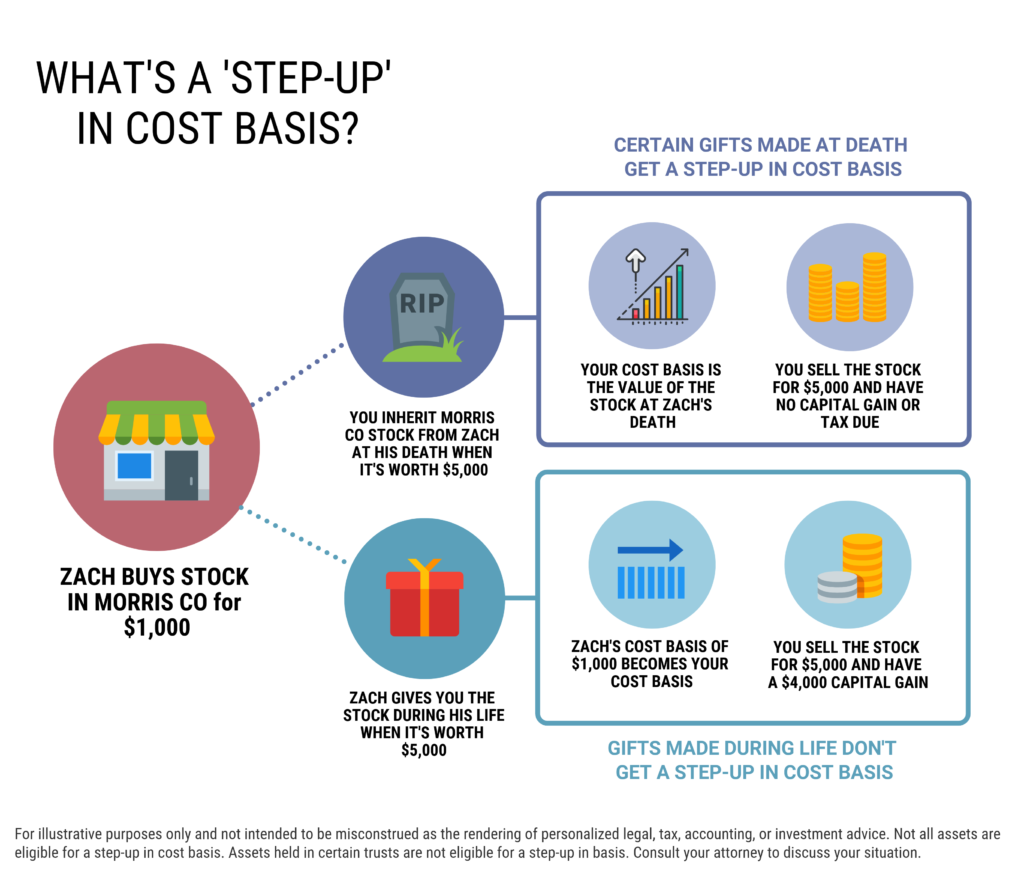
When stocks, bonds, ETFs, or mutual funds are inherited in a taxable brokerage account or joint or separate revocable living trust, the beneficiary generally receives a “step up” in cost basis. A stepped up basis increases the value of the asset for tax purposes to the market value at the time of death.
When you sell the stock or asset, you’ll pay capital gains taxes on the difference between the step up cost basis and sale price. There’s no holding period requirement. In theory, you could sell it right away and still get a stepped up cost basis. In practice, the estate settlement process takes time. You’ll need to work with the financial institution to get everything properly retitled and the new cost basis applied.
What happens if the asset declined in value? Sometimes, an inherited asset is worth less at death than the decedent paid for it. Then it’s a step-down in tax basis to the current value.
If you sell at a loss, you can offset other investment gains plus an additional $3,000 against other income in 2024. If your loss is greater than this amount, you can carry it forward to future tax years. The holding period for inherited securities is always considered long-term, regardless of when it was purchased by the decedent.
Example of a step-up in tax basis on stocks inherited at death
What types of assets are eligible for a step-up?
Non-retirement assets such as a brokerage account, inherited home, antiques/art/collectables, or other real estate, will generally be eligible receive a step-up in cost basis.
Retirement accounts and IRAs do not receive a stepped up basis. This is why sometimes it’s more advantageous to leave a brokerage account to heirs instead of a retirement account. (Planning note: as a result of the Secure Act passed in 2019, the ‘Stretch IRA’ is dead and non-spouse beneficiaries of a retirement account will only have 10 years to take the funds – at most. In 2022 the IRS proposed requiring annual distributions during this period for some heirs. As of April 2024, there has been no final guidance issued and the penalty for not taking RMDs will be waived again this year.
It’s also worth noting that the step-up in basis doesn’t just happen automatically. You’ll need to fill out paperwork with the custodian if there wasn’t a financial advisor managing the accounts. Inherited real property, like a house, will need to be appraised by a professional. Similarly, interests in a closely-held business will also need a professional valuation.
Eligibility for a stepped-up cost basis involves the type of asset inherited, ownership at death, and state laws. Whether the decedent was your spouse, parent, or other type of non-spouse doesn’t really matter. The exception is for community property states, which typically have the most favorable step-up laws.
Read: Inheriting a Trust Fund: Distributions to Beneficiaries
Do assets owned in a trust receive a step-up in basis?
Yes and no. If the asset was held in a revocable (or living) trust before the owner died, it will likely be eligible for a step-up in cost basis. Financial accounts aren’t the only assets that can be held in trust. A house can be put in trust and other types of real property as well.
Assets owned in an irrevocable trust likely won’t receive a step-up in basis. At a high level, if the asset is part of the decedent’s estate it’s typically eligible for a step-up. This can get very tricky so it’s important to work with the estate planning attorney settling the estate.
Assets that bypass the estate through a trust or another mechanism are usually not eligible for a step-up in basis.
What’s The Best Thing To Do With Inherited Money?
Can an account or asset receive a step-up in basis more than once? Explaining the double step-up
Yes. Depending on how your estate plan is structured, it’s possible to get a step-up at the death of the first spouse, and then another when the surviving spouse dies. Keep in mind, that can also mean paying estate tax on the assets eligible for the second step-up.
As with anything, this is a trade-off. A credit shelter trust only receives the first step up, but bypasses estate taxation. Therefore, it isn’t just about considering assets at their current value, but also being thoughtful about which assets are likely to appreciate and the most appropriate vehicle to achieve your legacy goals though the estate planning process.
Planning after sudden wealth from an inheritance
For help integrating an inheritance into your financial situation, contact a wealth advisor today. A large inheritance can significantly change your financial situation and make financial goals more attainable.
Darrow Wealth Management is a fee-only financial advisory firm and full-time fiduciary. We specialize in helping individuals manage sudden wealth events. By integrating financial planning with investment management, our goal is to help you build and grow your wealth. Learn more about our Wealth Management Services and how we may be able to help you.
The material in this article is intended to provide generalized information only as to some of the financial planning considerations of joint or separate trusts and should not be misconstrued as the rendering of personalized legal or tax advice. We strongly recommend you consult an estate planning attorney in your state to discuss your personal situation and estate planning needs.