

Key Takeaways
- Start by determining how much you’ll need from the sale to retire comfortably, as 70% of owners need to sell for retirement, according to a 2023 Exit Planning Institute study
- Clarify your goals, timeline, and financial needs before starting the process
- Consider your net proceeds from the sale, accounting for taxes, selling costs, and nonguaranteed payments, as the actual cash available at closing may differ significantly from the purchase price
- Understand how valuations work in your industry and the sensitivities between key metrics and sale prices, including what’s realistic
- Confirm your spending and major purchase goals align with your portfolio; if not, you may need a higher sale price or revised spending plans
Should I Sell My Business? Start With What You Need
Most owners start with the sale price. Maybe it’s just a number they always had in mind. But what will a buyer pay? And what’s the business worth? Importantly, how much do you need to retire?
According to a 2023 Exit Planning Institute study, 70% of business owners say they need to sell to retire. If the sale has to fund the rest of your life, the real question is what you need, and whether a sale can deliver it. If you can’t sell your business now for the number you need, work with advisors to uncover ways to maximize the sale price, and get a plan in place to increase the valuation over a reasonable timeframe.
Knowing your number before you go to market tells you which offers work, which terms you can accept, and when you can walk away.
Do You Want Out, or Need Out?
Start with the work side. Do you want a full exit, a transition to family or employees, or partial liquidity with a partner or investor?
Be specific about timing, too. “Five more years” isn’t a plan. Getting the highest price often means a full sale to a strategic buyer. It’s not uncommon for buyers to want the owner to stay on for a while. You may end up working for someone else in what used to be your business.
Then ask the same question about money. What do you need to cover your baseline needs, and what would be nice to have? Most exiting business owners want to buy a new home. Make sure to factor in upfront cash needs and ongoing expenses.
What Do You Really Spend?
No one knows what they spend. Business owners have an extra problem: the company may be offsetting some of your ongoing costs of living.
Costs the business pays for you today
When you sell, these become personal expenses:
- Health, life, and disability insurance
- Cars
- Phones and technology
- Subscriptions
- Travel and meals tied to the business
Add them back to your household budget.
Big purchases and gifting after the sale
A sale changes how people live. In my experience, almost everyone buys a new home. Many also plan bigger travel, help adult children, or want to give more.
Put real figures on these now. Every dollar spent up front is a dollar that can’t support you later.
Gross vs Net: How Much You Keep From a Sale
The purchase price and your final net proceeds are two very different things. Escrow, earnouts, rolled equity, and taxes all reduce your cash at closing, and some of that money may never come.
Here’s a simplified example of how a $20 million sale can shrink. The figures are illustrative.
| Getting from Gross to Net | Amount |
| Purchase price | $20,000,000 |
| Equity rolled into the buyer | –$4,000,000 |
| Escrow/holdback | –$1,500,000 |
| Earnout (contingent) | –$2,000,000 |
| Cash at closing | $12,500,000 |
| Estimated federal tax on cash at closing (assuming no basis and 100% long-term capital gain) | –$2,975,000 |
| Money you have to work with at closing | $9,525,000 |
Until the escrow, earnout, and equity rollover pay out, they shouldn’t be part of your planning calculations. Taxes depend on deal structure, so run them by your CPA.
What the table doesn’t show
The table above illustrates how rollover equity, taxes, and other closing items reduce your cash in hand at closing to less than half of the gross purchase price. While some of these line items should be recouped, there are others that we didn’t show in the simple example. Here are some other real costs that can reduce your net take-home when selling a business:
- Attorney fees
- Accounting/tax advisor fees
- Business broker/investment banker fees
- State tax (both your state of residence and potentially the states the business operates in)
- Working capital adjustments
- Pre-tax versus after-tax equity rollovers
Can You Retire If You Sell Your Business Now?
Now compare what you spend to what you’d keep. Below are two starting portfolios funded with $10M and $15M of net, cash proceeds, after taxes and upfront major purchases. A safe annual withdrawal amount (in today’s dollars) was calculated for both a 25- and 45-year retirement horizon.
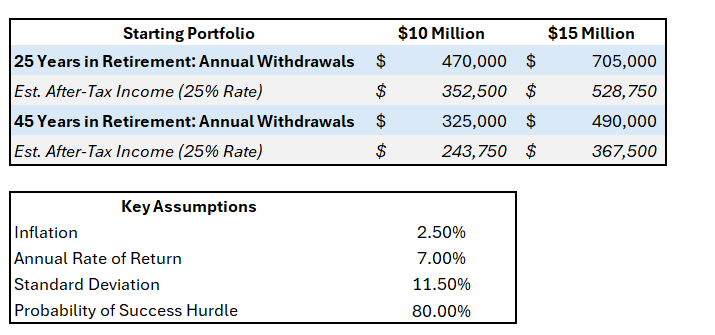
Estimating your net figure is key when determining if you should sell your business now. And don’t forget, any major purchases can quickly eat into the proceeds you have to invest after the sale.
If your spending fits within the realm of what a diversified portfolio may be able to support, you have flexibility. If it doesn’t, you need more time, a higher price, better terms, or a different spending plan. All of those are easier to work on before you sign a letter of intent.
When to Sell Your Business: What the Numbers Tell You
There’s a lot that goes into the decision to sell a business. And like most things in life, timing is everything.
The numbers point toward selling when you’ve taken the business as far as you’re able and the net after-tax proceeds can support your lifestyle goals with a margin for safety. They point toward waiting when there’s a gap you can realistically close by growing the business, making it more profitable or marketable for sale, or reducing its dependency on you. Also, some businesses can provide owners with significant cash flow relative to the sale price. So having another few years to direct profits toward your retirement can also be the difference.
Life matters too. The same Exit Planning Institute study found half of exits are forced by one of the five Ds: death, disability, divorce, distress, or disagreement. The best time to sell is usually on your own timeline, not one of those.
Should I Sell My Business Now or Wait?
Waiting has its own risk, and you can’t control outside forces. Valuations can change fast: consider a company that manufactures masks for healthcare workers. Imagine the valuation changes between 2019 and 2020. After vaccines came out, valuations likely returned to pre-Covid levels. Now consider the implications for a government consulting firm in the crosshairs of the DOGE cuts in 2025.
If you’re waiting, use the time to lower your risk. Here’s how.
Build liquid assets outside the business
For most owners, the business is nearly all of their net worth. A high savings rate and money outside the company can greatly reduce risk. Don’t reinvest 100% of your profits back in the business, as it doesn’t diversify you. Also, keeping too much cash in the business can work against you when working capital is adjusted.
Diversify around the business
Your business is 100% equity, so your outside portfolio can lean toward fixed income or exclude your industry. Here’s more on diversifying as a business owner.
Bank tax losses before the sale year
Tax-loss harvesting through direct indexing can build carryover losses to offset capital gains when you sell. Capital losses are tax assets that can be carried forward to future tax years if losses exceed gains in the calendar year.
Financial Advisory Support for Exiting Business Owners
If you’re considering selling your business, partner with a fee-only fiduciary first. Darrow Wealth Management supports business owners before, during, and after a liquidity event from selling a business. Speak with a Darrow Wealth Advisor today.
Book a Consultation with a Wealth Advisor
Common Questions About Selling Your Business
It depends on whether your after-tax proceeds can support your spending. If they can’t yet, keeping it and lowering your risk may make more sense. If you cannot continue the business for other reasons, or if you expect the sale price to decline further due to other factors, you may be faced with a difficult decision to scale back your lifestyle.
When the numbers work and you want out, or before an unplanned event forces the decision. Almost half of owners want to exit within five years, so start planning early.
Less than the purchase price. Escrow, earnouts, professional fees, rolled equity (common with private equity buyers), and taxes all reduce the cash you receive at closing.
No. Build your plan on cash you control at closing (net of taxes that you’ll owe on the sale, even if they’re not due just yet).
[Last reviewed October 2026]
Disclosures
Examples in this article are strictly hypothetical and for illustration purposes only. Past performance is not indicative of future results. This is a general communication for informational and educational purposes only. This article is not personal advice or a recommendation for any specific investment product, strategy, or financial decision. This material does not contain sufficient information to support an investment decision and it should not be relied upon by you in evaluating the merits of investing in any securities or products. If you have questions about your personal financial situation, consider speaking with a financial advisor.
Return and volatility assumptions used in this analysis are hypothetical in nature and do not reflect the actual or expected future performance of any specific index, security, or investment strategy. Transaction costs and other investment expenses were not considered in this analysis. For simplicity, the components of return are not considered, therefore the analysis assumes the entire return is price appreciation. After-tax figures assumed a flat 25% tax rate and zero cost basis. In practice, the nature of the account, asset, and type of taxable income will produce different results.