
What’s best thing to do with a large inheritance? As you consider what approach is right for inherited money, understand the complexities of managing a large inheritance, financial planning strategies, and how taxes work on inherited assets and property.
Key Takeaways
- Don’t assume it’s yours until it is. Find out what you’re inheriting and when you’ll get it, then keep the cash in a safe, interest-bearing account while you get organized.
- Estimate the taxes and set that money aside before you spend, invest, or give away any of it. Inherited IRAs can push you into a higher tax bracket, but a step-up in basis can wipe out capital gains on inherited stocks or a house (legally, of course!).
- Hold off on big purchases, paying off the mortgage, or other lifestyle changes. You can only spend a dollar once!
- Invest the money based on your own goals, not those of the person who left it to you. Don’t keep a large stock position or a stake in the family business just out of loyalty.
- Protect the inheritance. Keep it in your name only and update your own estate plan, because a large inheritance can change your estate tax picture overnight.
Inheritance planning and next steps
When someone receives a large inheritance, it’s not uncommon for inherited assets to come through a trust or taxable brokerage account. Ultimately, the best thing to do after receiving an inheritance is to take your time and work with your financial, tax, and legal advisors to fully understand the implications and your options with the inherited money. Then, depending on your current financial situation, goals, and the type of assets you inherit, you can develop a plan for the financial windfall.
This article is simply an overview of the tax treatment and primary options after inheriting significant wealth. Please contact us to discuss managing and investing an inheritance and how we may be able to help you navigate next steps.
What to do with inheritance money: first steps
Figuring out what to do with a large inheritance starts with getting organized, not making big changes. Here’s a simple timeline to help you prepare while the estate settles, which takes time. For more detail, see our first 90 days checklist.
Step 1: Confirm what you’re inheriting and protect the cash
- Confirm what you’re actually receiving, and when. Talk to the executor or trustee about timing, especially if assets are going through probate or staying in trust.
- Park cash somewhere safe. A checking account isn’t the place for large sums of inheritance money. Use a safe, interest-bearing account and keep FDIC limits in mind.
- Estimate taxes and set that money aside first. Do this before spending, investing, or giving any of it away. Work with your CPA or tax advisor and the executor and trustee of the estate to understand the tax treatment of assets you are inheriting.
- Hold off on big decisions. No major purchases, large gifts, or paying off the mortgage yet.
Step 2: Review risk and your own plan
- Look at concentration risk. An inherited stock position, a stake in a family business, or real estate may make up a big piece of what you received.
- Update your balance sheet. Inventory your personal accounts, titling, debt, and insurance, and where the inherited assets will fit.
- Review your estate plan and beneficiaries. A large inheritance can change your estate tax picture overnight. While you wait for the estate to settle, understand the structure of your estate plan, so you’ll be better positioned to make updates once the inherited money is under your control.
- Keep it in your name only, at least until you decide otherwise (more on that below).
Step 3: Build the plan
- Decide what the money is for. Rank your goals by importance and timing. Quantify your goals, too.
- Map out inherited IRA withdrawals before the first required distribution deadline. You may need to take a RMD before year end.
- Start implementing. Set an investment plan and a timeline for diversifying with your financial advisor, and coordinate next steps with your CPA and estate attorney.
What to Do When a Parent Dies and You’re the Executor
Inherited IRA or retirement account
If you inherit a traditional IRA, 401(k), or other types of tax advantaged retirement accounts from a parent, you must take the money in 10 years or less. There are a few exceptions to this rule. Depending on the age of the original owner, some beneficiaries also need to take annual withdrawals during the 10-year period, called RMDs.
Although options are limited, there are some strategies to maximize the benefits of inheriting a retirement account from a non-spouse.
This section covers some of the technical rules on when you must withdraw from inherited retirement accounts. But don’t just spend money because it is distributed. We’ll discuss financial planning after receiving a large inheritance later on.
Options after inheriting a retirement account from a parent
- Understand the rules and tax treatment of inherited IRAs
- Run an analysis to optimize distributions for income tax purposes. Consider changes to state residency, income changes, and other factors like college financial aid and Medicare premiums (which use tax returns from two years ago)
- Prolong the benefits of tax-deferred growth in a tax-deferred account as long as possible (all else equal)
- Make a plan to reinvest the money in a brokerage account. Without making a deliberate plan to save the money from your inheritance, it’s easy to spend it
Options after inheriting a retirement from a spouse
Spouses have a lot more flexibility when they’re the sole beneficiary of an inherited IRA or 401(k). While not an exhaustive list of options, for most spouses, these are some of the best things to do with an inherited IRA:
- Spousal rollover
- Inherited IRA
- Elect to be treated as the original account owner (your late spouse). This is a new option starting in 2024
Again, there are other options after inheriting an IRA from your spouse. But typically, the above approaches enable the surviving spouse to have the most flexibility and extend the benefits of tax-deferred growth.
Inheriting a house
Inheriting a house can be emotional. Assuming you’re not already living in the house or want to move your primary residence, you may have some difficult decisions to make, including understanding the tax implications of keeping or selling the home. Especially for individuals inheriting a family home or vacation house with siblings, everyone may not agree on what to do with the property.
What should you do with an inherited house?
- Be realistic about the effort/cost in maintaining the property, how much you’ll use it, and the overall financial impact of keeping the house
- Tax rules: consider whether the house is eligible for a step-up in basis and factor any tax savings into the analysis
- Objectively consider whether the decision is emotionally driven vs an investment. Keeping the house purely for sentimental value isn’t always a bad idea, but it depends on carrying costs and financial implications for the rest of your situation
- Formalize any agreements before agreeing to a co-ownership situation with family members
Selling an inherited house is typically the cleanest way to go, but it’s not right for everyone. Depending on family dynamics, owning a home with relatives may not work out, and a buyout may not make financial sense.
Do you have to pay taxes on an inheritance?
What can you do with inheritance money to avoid taxes? There are several ways an inheritance can be taxed depending on the situation. Whether the estate pays or the end beneficiaries, it still means less inheritance money is left for family members.
As someone receiving an inheritance, you don’t pay tax directly at the federal level simply because you inherited money. But you may need to pay income taxes on withdrawals from inherited retirement accounts or capital gains taxes from investment income or asset sales. And keep in mind, if you inherit a trust fund, the tax implications may be different, along with the state tax treatment.
Federal estate tax
Large estates may be subject to federal estate tax if they exceed the exemption. The current estate tax rate is 40%. Although the estate must pay, it can leave less money left for heirs. The federal estate tax exemption is $15,480,000 per person in 2027.
State estate tax
A handful of states impose their own estate tax and exemption amounts. The tax rate is much lower than the federal system, but the exemption amounts are also smaller. Again, the estate pays, but it also means less is leftover for beneficiaries. In all, 12 states (Connecticut, Hawaii, Illinois, Maine, Maryland, Massachusetts, Minnesota, New York, Oregon, Rhode Island, Vermont, Washington, as well as Washington D.C.) have their own estate taxes.
State inheritance tax
Only a few states have an inheritance tax, which is usually paid by the you, the person who inherits the money. Those states are Kentucky, Nebraska, Pennsylvania, New Jersey, and Maryland. The exemption amounts vary by state, and whether a tax is imposed at all may also depend on your relation to the decedent.
Taxes on inherited retirement accounts
You may pay taxes multiple times on the money you inherit. Retirement accounts like inherited IRAs are included in the taxable estate and non-Roth withdrawals are also subject to personal income taxes. Similarly, capital gains taxes also apply on sales of an inherited family home or taxable investment account.
Avoiding taxes on certain inherited assets and property with a step-up in basis
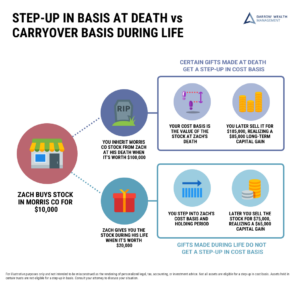
Inheriting stocks or a home can be a huge opportunity to avoid taxes (legally of course!) on unrealized gains if beneficiaries are eligible for a step-up in basis.
This is a major advantage as the cost basis of stocks or other assets are ‘stepped up’ to the value on the date of death. With a step-up, assets can be sold right away without incurring capital gains taxes. In practice, if an inheritance goes through the probate process, it may take a few months or more to access.
Will your inheritance go through probate?
Certain types of assets will avoid probate whether or not there was a will in place.
- Beneficiary designations. Accounts like IRAs, 401(k)s, and transfer on death/payable on death elections, along with life insurance proceeds, won’t go through probate unless there’s an issue with the beneficiaries on file.
- Trusts. Trusts will also bypass probate, which is a central reason to set up a trust. Whether the decedent established a revocable or living trust during their lifetime, or the estate plan details that certain assets will pass to newly created trusts upon death, these assets may not be subject to probate. A wide range of assets can go into trust, but you’ll need to speak with the trustee about your situation and share. Common examples include real estate, art, cash, investment accounts, and so on.
- Titling. Assets owned jointly, often by marriage, may pass to the spouse, avoiding probate. States have different rules about ownership in this regard so it will ultimately depend on the state you live in and the physical location of the assets, if any.
If inherited money doesn’t fit anything on this list, it might go through probate.
Financial planning strategies for a large inheritance
Once you know what you’re inheriting and what you’ll owe in taxes, it’s time to make a plan. Here are some of the key planning strategies for a large inheritance. We go deeper in what to do with a windfall.
Run the numbers before changing your lifestyle
How much you spend matters more than how much you inherit. A big cash home purchase plus higher annual spending can drain a multimillion-dollar inheritance faster than you’d think. Model what the money can realistically support before committing to anything (mentally or otherwise).
Cash flow and tax planning, especially for RMDs
Financial projections can help you bring your goals together with your income, RMDs from inherited retirement accounts, and any taxes you owe on the inheritance. Once your current cash flow and tax picture is more clear, it’s time to optimize.
Especially for adults receiving an inheritance in their prime earning years, large taxable withdrawals from inherited IRAs can push you further into the highest tax brackets. Some planning strategies include only taking the minimum during high income years, filling up a tax bracket, equalizing withdrawals, considering IRMAA impact, and ways to avoid a tax bomb in year 10.
Invest based on your goals, not theirs
Decide whether to invest a lump sum or phase in over time, and consider a Treasury ladder for near-term needs. Then set an asset allocation that fits your time horizon and risk tolerance, which may look nothing like the portfolio you inherited. Concentrated holdings with an emotional attachment can derail an investment plan. Because of the tax benefits of the basis step up, it’s often an intentional to leave a large stock position to family, as they can usually sell out of the position and rebalance without tax implications.
Protect the inheritance as separate property
In most states, an inheritance is considered separate property in a divorce, but only if you keep it separate. Depositing it in a joint account or using it to pay down a jointly owned home can turn it into marital property. If protection matters to you, keep it in your name alone or in a trust, and talk to your estate attorney.
Consider a qualified disclaimer
If you don’t need the money, you may be able to disclaim all or part of an inheritance so it passes to the next beneficiary in line, often your children, without using your own gift and estate tax exemption. Timing is strict: generally within nine months of the date of death and before you accept any of the assets.
Use lifetime gifting and charitable planning
If your estate is now larger than you’ll ever need, lifetime gifts can move future growth out of your taxable estate. Annual exclusion gifts, front-loading 529 plans, and a donor-advised fund are common places to start.
Dos and don’ts after receiving a large inheritance
Don’t assume it’s yours until it is
One of the most common mistakes people make when it comes to inheritances is assuming that they will receive a certain amount of money or assets. There are many factors that can affect how much you inherit, including the deceased person’s debts, taxes, pending lawsuits, claims or disputes against the estate, creditors, family situations like divorce or blended families, and so forth.
Unless you’re the executor (and possibly trustee) you may not have visibility on who-gets-what. So even if you’re expecting to receive an inheritance, consider waiting until you actually do before making any personal finance changes.
Make decisions slowly
When you receive an inheritance, take your time and don’t make impulsive decisions, especially to your lifestyle expenses. One of the biggest mistakes people make is spending the money too quickly or making impulsive investments. Seek professional guidance from a financial advisor and create a plan for using the inheritance that aligns with your financial goals and values.
Don’t hold onto a concentrated position out of loyalty
It’s natural to feel attached to a parent’s favorite stock or the family business. But keeping a large position for sentimental reasons can put your whole plan at risk, especially when the step-up in basis may let you diversify with little tax.
Don’t be too generous, or afraid to say no
Once word gets out about an inheritance, requests from friends and family tend to follow. Make a gifting plan before agreeing to anything. It’s fine to say you need time, or to blame your advisor.
What’s the best thing to do with a large inheritance?
Deciding what to do with an inheritance is a big, often emotional, decision. Unfortunately, there are usually also time constraints to be aware of. Further, any action (or inaction) taken may not be reversible. As tempting as it may be to use a lump sum to buy a home or buy a car, it’s important to consider the alternatives for a sudden, one-time windfall.
Darrow Wealth Management supports individuals inheriting a retirement account, trust fund, or other assets. Darrow Wealth is a fee-only wealth management firm and fiduciary specializing in helping individuals who experience a large windfall from an inheritance. Consulting with a tax and financial planner can provide significant tax advantages, enhancing your overall approach to wealth management.
For help managing a large inheritance: schedule a consultation
What to do with inheritance money FAQ
The first thing you should do after inheriting money is keep the money in a safe account and don’t spend it while you get organized and make a plan. You’ll need to find out the nature of the assets you inherited, personal tax implications for you, deadlines to be aware of, and if you expect to inherit more money.
Spending it all right away is something you should avoid doing after receiving an inheritance. Although you ultimately may decide this is the best use of a smaller inheritance, you should always consider the alternatives and trade-offs before blowing through an inheritance.
[Last reviewed November 2026]