

Is it always a good idea to max out your 401(k)? Typically, yes; always, no. Individuals with a sizeable pension might not want to max out contributions to a 401(k), for example. Here are some situations where maxing out your 401(k) might not make sense.
Key Takeaways
- Maxing out your 401(k) is usually a good idea, just not in every situation; factors like pensions and existing account balances matter.
- Contributing enough, and at the right cadence, to maximize an employer match is key to capitalizing on free money.
- For high earners, pre-tax contributions can provide tax benefits during high-income years, but may lead to higher RMDs later.
- In many cases, balancing 401(k) maxing with other investment options can yield better outcomes.
Should I max out my 401(k) every year or invest elsewhere?
Is it always a good idea to max out your 401(k)? For wealthier retirees or individuals with a sizeable pension, you might not want to max out contributions to your 401(k). Here are some situations where maxing out your 401(k) might not make sense.
The short answer: most people should contribute at least enough to get the full employer match, and most high earners should still max out their 401(k) in their peak earning years, especially if you’re expecting significant wealth from a business sale or equity compensation the same year. But if you already have large pre-tax balances or a big pension, putting every dollar possible into pre-tax accounts can mean a bigger tax bill later. In those cases, splitting savings between a 401(k), considering Roth accounts and HSAs, and a taxable brokerage account is often the better move.
Should I max out my 401(k) every year?
As a CERTIFIED FINANCIAL PLANNER™ professional, I’m often asked the best way to save and invest for retirement. For most people, it begins with maxing out contributions to a 401(k) or 403(b) retirement plan. But should everyone max out their 401(k)? No.
Universal rules are scarce in financial planning because everyone’s financial circumstances are different. There are many ways one investor’s situation will vary from another’s: amount and type of retirement assets, expectations of a pension, other assets such as real estate or an inheritance, access to different types of retirement plans and ability to contribute, current cash flows, expected income needs in retirement, legacy goals, and so on.
Situations where maxing out your 401(k) might not make sense
There are so many unique situations that could happen, an exhaustive list doesn’t exist. But here are several situations when to consider not maxing out your 401(k):
- If you can’t afford it (obviously)
- Temporarily when cash is tight (putting kids through college, recovering from a recent layoff or furlough, saving for a home, major unexpected costs, etc.)
- If you already have large, mandatory tax-deferred retirement contributions (e.g. partners at law firms often have to make profit-sharing and cash balance contributions)
- You’re planning to retire early, before most retirement money is available at age 59 1/2
- You may need the money for non-retirement goals before retirement (second home, college, boat, car, wedding, etc.)
- If you already have a very large IRA, 401(k), 403(b), inherited retirement account, or pension (very large is relative of course…work with a financial advisor to run the numbers)
- If you are required to make employer-side contributions to a retirement plan and funding at the individual level is optional (more common as a law firm partner or business owner)
Comparing different types of investment accounts: IRA vs 401(k) vs brokerage account
- 401(k), 403(b), traditional IRA, SEP IRA, SERP: Pre-tax contributions, tax-deferred growth, taxable income in retirement
- Roth IRA or Roth 401(k): After-tax contributions, tax-free growth, tax-free in retirement
- Brokerage account: After-tax contributions, taxable growth (which can qualify for favorable long-term capital gains rates)
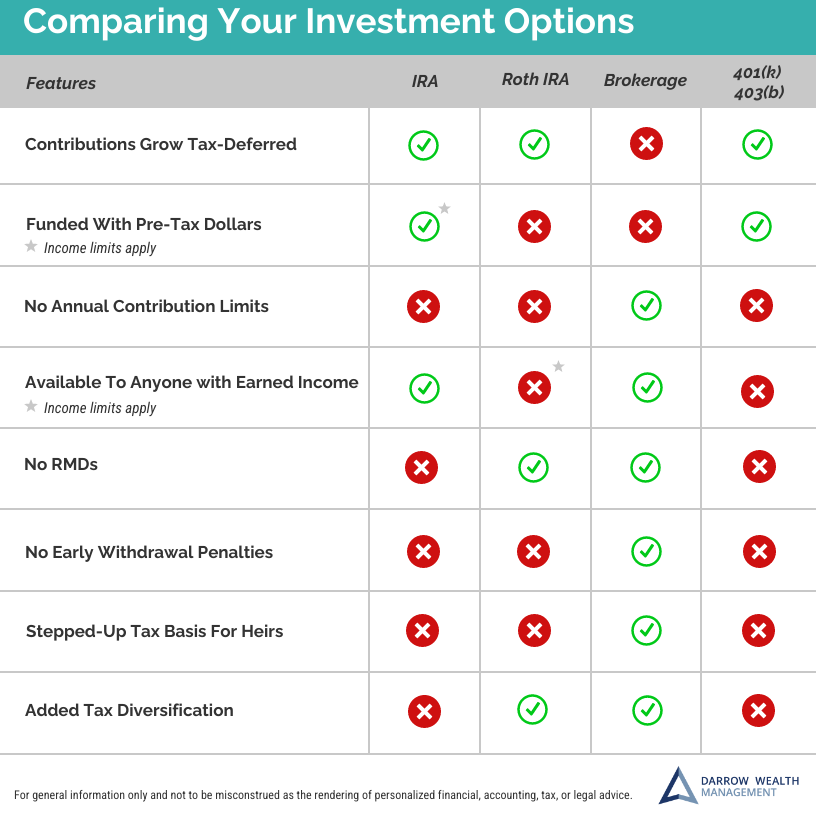
It doesn’t always make sense to max out your 401(k): the downside of pre-tax retirement accounts
The most notable drawback is the requirement to take distributions from your accounts, called required minimum distributions (RMDs). Under current law, RMDs from tax-deferred retirement accounts begin at age 73, or 75 if you were born in 1960 or later.
How RMDs are calculated
At a high level, the amount you’ll need to withdraw annually equals the balances of traditional IRAs and tax-deferred retirement accounts divided by the life expectancy factor listed in the IRS’ Uniform Lifetime Table, which is based on your age. (This article has more on RMDs and how they’re calculated.)
Of course, as your pre-tax savings grow, the amount you’ll need to withdraw will also increase. Required minimum distributions are taxed as ordinary income. This can push wealthier retirees into a higher tax bracket. This is particularly true when considering how other aspects of your tax situation may change in retirement. Higher taxable income in retirement can also raise Medicare premiums through IRMAA surcharges and expose more of your investment income to the 3.8% net investment income tax.
For example, during working years many individuals have various pre-tax deductions from their paycheck: retirement contributions, additions to a health savings account or flexible spending account, or contributions to a deferred compensation plan or SERP. In retirement, these ways to reduce your taxable income disappear.
After considering the impact of social security income and whether you’re able to continue itemizing your deductions, retirees may find themselves with fewer tax planning options. This is especially true if you paid off your mortgage.
Investing outside of tax-deferred retirement accounts
No limits or penalties
A brokerage account allows investors complete flexibility: there are no contribution limits, eligibility criteria, or rules about when you may access the funds. There are, however, no tax benefits associated with this type of investment account. A brokerage account is taxable annually, including any dividends you receive and if you incur taxable capital gains (or losses) throughout the year.
The capital gains tax rate will depend on your holding period. Long-term gains are taxed more favorably than short-term, where the tax rates are the same as ordinary income.
A brokerage account helps fund an early retirement
Investing outside of retirement with a brokerage account can serve a variety of purposes. This is especially true for high-earning investors with a high savings rate. In exchange for the loss of tax-deferred growth, a brokerage account can be a great way to help bridge the income gap early on in retirement.
Leaving an inheritance with tax benefits
If you want to leave an inheritance to your children, a brokerage account can offer unique tax benefits from an estate planning perspective.
Assets in a brokerage account will receive “stepped-up” cost basis when passed to heirs. This means securities in the account are valued as of the date of death instead of your cost basis. Assets receiving this “step-up” treatment are taxed as long-term capital gains, regardless of the actual holding period. As this is not a type of retirement account, there are no requirements for you – or your heirs – to take distributions.
By contrast, most non-spouse beneficiaries who inherit a 401(k) or IRA must empty the account within 10 years, often during their own peak earning years. Here’s more on how inherited retirement accounts are taxed.
Control taxes in retirement
By shifting retirement assets from fully concentrated holdings in tax-deferred accounts to being more evenly distributed among taxable and/or tax-free accounts, retirees may be able to have more control over their tax situation in retirement.
Should you invest with a tax-free Roth IRA or Roth 401(k) instead of a brokerage account?
Roth IRAs aren’t taxed annually and withdrawals in retirement can be tax-free. To qualify, at least 5 years must have passed since your first Roth contribution was made and you’re at least 59 1/2. Another benefit is that there are no required minimum distributions on Roth IRAs or, under current law, Roth 401(k)s.
Income limits prevent high-earners from making regular contributions
The ability to contribute to a Roth IRA phases out at income levels many high earners exceed, and the IRS adjusts the ranges each year. If you are under these limits, the contribution limit is still relatively low. Many high earners get around the income limit with a backdoor Roth IRA: a nondeductible traditional IRA contribution followed by a Roth conversion. If you have other pre-tax IRA balances, the pro-rata rule can make part of the conversion taxable, so run the numbers first.
Roth IRAs may not make sense for high income workers anyway
The main reason to consider a Roth is the belief that you’ll be in a higher tax rate in retirement than you are today. If you have a high income, that might not be true. Then again, if you already have large pre-tax balances, RMDs and other income may keep you in a high bracket for life. That’s where tax diversification matters.
Regardless of income, any taxpayer can make a Roth IRA conversion. There’s no income limit or annual cap on conversions. If you’re in the middle of a job transition, it may be the right time to discuss your options for your old 401(k) plan and whether a full or partial Roth conversion makes sense. Lower-income years, like a gap after leaving a job, selling a business, or retiring early, can be a good window for conversions.
Some employers also offer a Roth 401(k) in addition to their traditional 401(k). With a Roth 401(k), investors at any income level are able to make after-tax contributions up to the annual employee deferral limit. Under current law, if you’re 50 or older and your prior-year wages were above an IRS threshold, your catch-up contributions must go in as Roth.
Calculator: Pre-Tax vs Roth 401(k)
Some 401(k) plans also allow after-tax contributions above the regular deferral limit, up to the plan’s overall annual limit, which can then be converted to Roth. This is often called a mega backdoor Roth, and for high earners whose plan offers it, it can be one of the most valuable ways to build tax-free savings.
Also, if you’re currently in the highest tax bracket or do not expect to stick with the strategy long enough to make Roth assets a meaningful part of your overall portfolio, the strategy may not be worth it.
Should high earners and wealthy investors max out their 401(k)?
Usually yes, especially during high-income years. If you’re in the top federal bracket and paying state income tax, a pre-tax deferral saves tax at your highest marginal rate. For high income families with substantial taxable income, there are more variables to consider.
- Liquidity events and equity compensation. In a year with an IPO or company sale, maxing out pre-tax contributions (and a cash balance plan if you’re a business owner) can offset some income at the highest rates. The lower-income years that often follow can be a window for Roth conversions.
- Large existing pre-tax balances. If you already have seven figures in IRAs and 401(k)s, future RMDs may be large on their own. Adding more pre-tax money may only defer taxes into a bracket that isn’t any lower.
- Estate planning. Pre-tax retirement accounts are often the least tax-efficient assets to leave to children, while taxable assets can get a step-up in basis. On the other hand, they can be a great asset to leave to charity, since charities don’t pay income tax.
- Liquidity and concentration. If most of your net worth is tied up in company stock, private investments, or a business, savings you can access without penalties give you more options.
- Ongoing tax deferral. High and ultra-high net worth individuals and families almost always hold the bulk of their assets outside of retirement accounts. So it’s possible that pre-tax retirement assets, as inefficient as they are in the withdrawal stage or as an inheritance, can still provide a meaningful tax shield for rebalancing and annually, as income and dividends aren’t taxable.
Other complexities when considering if you should max out your 401(k)
Landing at the best retirement saving strategy may require more complex planning. Multi-year projections require assumptions on income, expenses, tax laws, goals, family situation, and so forth. Further, the strategy that provides the best financial result may not be the best way to accomplish your goals. This is particularly true for philanthropic wishes and lifetime giving.
In most situations, it will be beneficial to max out a 401(k) and invest elsewhere. However, there are circumstances where it may be worth considering other avenues outside of traditional pre-tax deferrals, especially if you expect pension income.
[Last reviewed November 2026]